

Replica Watch Case Construction Quality: Structure and Assembly Explained
If you’re evaluating replica watch case construction quality, the most reliable clues are not “shiny photos,” but the hidden engineering: how the case is structured, how parts meet, and how sealing + tolerances are executed. This guide breaks down the anatomy and assembly logic so you can judge quality with clearer standards.
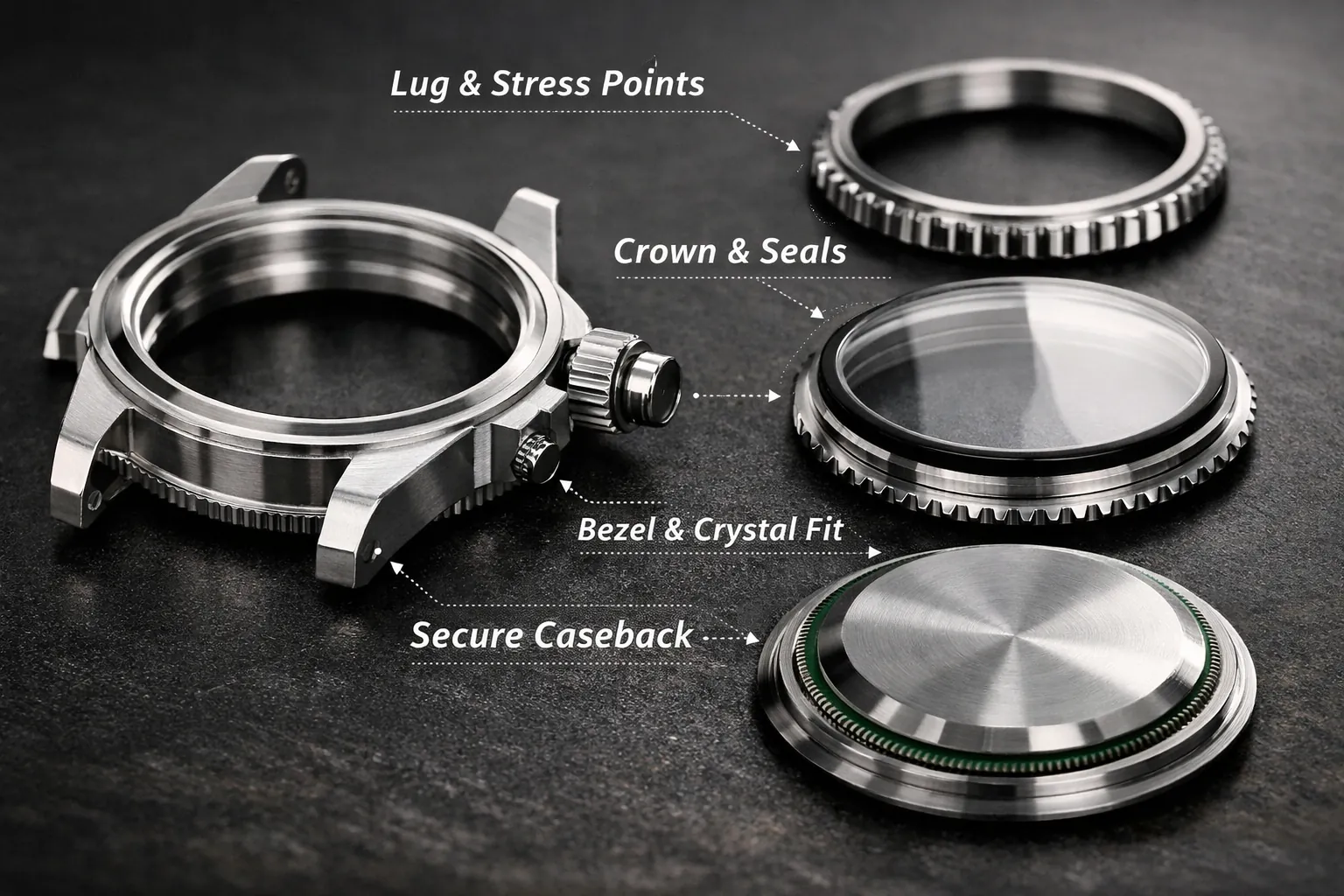
1) Case structure: the parts that decide rigidity and “feel”
A watch case looks simple from the outside, but it’s a system of interfaces. When people describe a case as “solid,” they’re usually responding to three things: rigidity (no flex), precision (no micro-gaps), and consistency (uniform finishing and alignment).
Mid-case, bezel, and caseback: the load-bearing trio
The mid-case is the structural core. Lugs, crown guards (if present), and the seating for the movement ring all depend on this one component. The bezel assembly (fixed or rotating) is where tactile quality shows up quickly: resistance, click feel, and the way the bezel sits flush without uneven shadows. The caseback seals the system and also affects comfort—its curvature and edge finishing determine how it sits on the wrist.

2) Assembly logic: where quality is won (or lost)
Case construction quality is most visible at the junctions: how parts meet and stay aligned under use. A “good-looking” case can still feel inconsistent if the assembly stack isn’t engineered well. Below are the core assembly zones that matter for replica watch case construction quality.
Crystal stack and bezel seating
The crystal and bezel aren’t just cosmetic. The crystal must sit evenly on its gasket seat; the bezel must compress and retain components without tilting. Uneven seating can show up as subtle distortion around the perimeter, inconsistent reflection bands, or a bezel that feels “high” on one side.
Crown tube, stem alignment, and sealing path
The crown area is the most handled interface: setting time/date, winding, and daily contact. Quality here is about alignment (smooth engagement), thread precision (if screw-down), and sealing continuity (gaskets seated correctly). A well-built crown assembly should feel predictable—no gritty bite, no wobble, no “half-catch” moments.
For a deeper look into how precision at junctions is evaluated, see case assembly tolerances .
3) Materials vs. construction: why finish alone isn’t the answer
Materials influence weight, scratch behavior, and the way edges catch light—but construction decides how everything holds together. Two cases can share a similar polish and still differ dramatically in daily handling if the internal seats, threads, and gasket channels are cut to different standards.
If you want a practical breakdown of how common case materials behave (and what that means for real wear), read replica watch case materials explained .
| What you’re observing | What it usually indicates | How to judge it quickly |
|---|---|---|
| Bezel sits evenly, consistent shadow line | Stable seating + controlled tolerances | Check gap uniformity around the full circle |
| Crown engagement feels smooth & repeatable | Good stem alignment + threads + sealing design | Try multiple pulls/pushes; look for wobble or bite |
| Caseback edge finishing feels clean (no sharpness) | Better machining + finishing discipline | Run fingertip around edge; note any “catch points” |
| Lug transitions look crisp but not harsh | Controlled chamfers + consistent polishing | Check symmetry across left/right lugs |
4) A practical checklist for evaluating construction quality
Use the checklist below as a neutral way to compare models or batches. It avoids hype and focuses on construction signals that tend to stay meaningful over time.
- Interface consistency: gaps (bezel/crystal/caseback) look uniform from all angles.
- Control feel: crown and bezel actions feel predictable with no sudden “dead zones.”
- Edge discipline: no sharp corners where the case meets the wrist or strap/bracelet.
- Alignment logic: rehaut/dial seating appears centered; case silhouette feels symmetrical.
- Sealing confidence: gasket seats look clean; parts compress evenly rather than forcing fit.
5) Putting it together: what “good construction” looks like in daily wear
In real use, construction quality shows up as stability: the bezel stays consistent, the crown stays smooth, the caseback stays comfortable, and the watch keeps its “tightness” even after handling. That’s the essence of replica watch case construction quality—not just appearance, but engineering coherence.
If you’d like a broader, system-level walkthrough of how watch builds are evaluated (beyond just the case), this reference can help: watch construction quality explained: structure and assembly .