


Watch Power Reserve Explained: What It Means for Daily Use
What “power reserve” actually measures (in plain language)
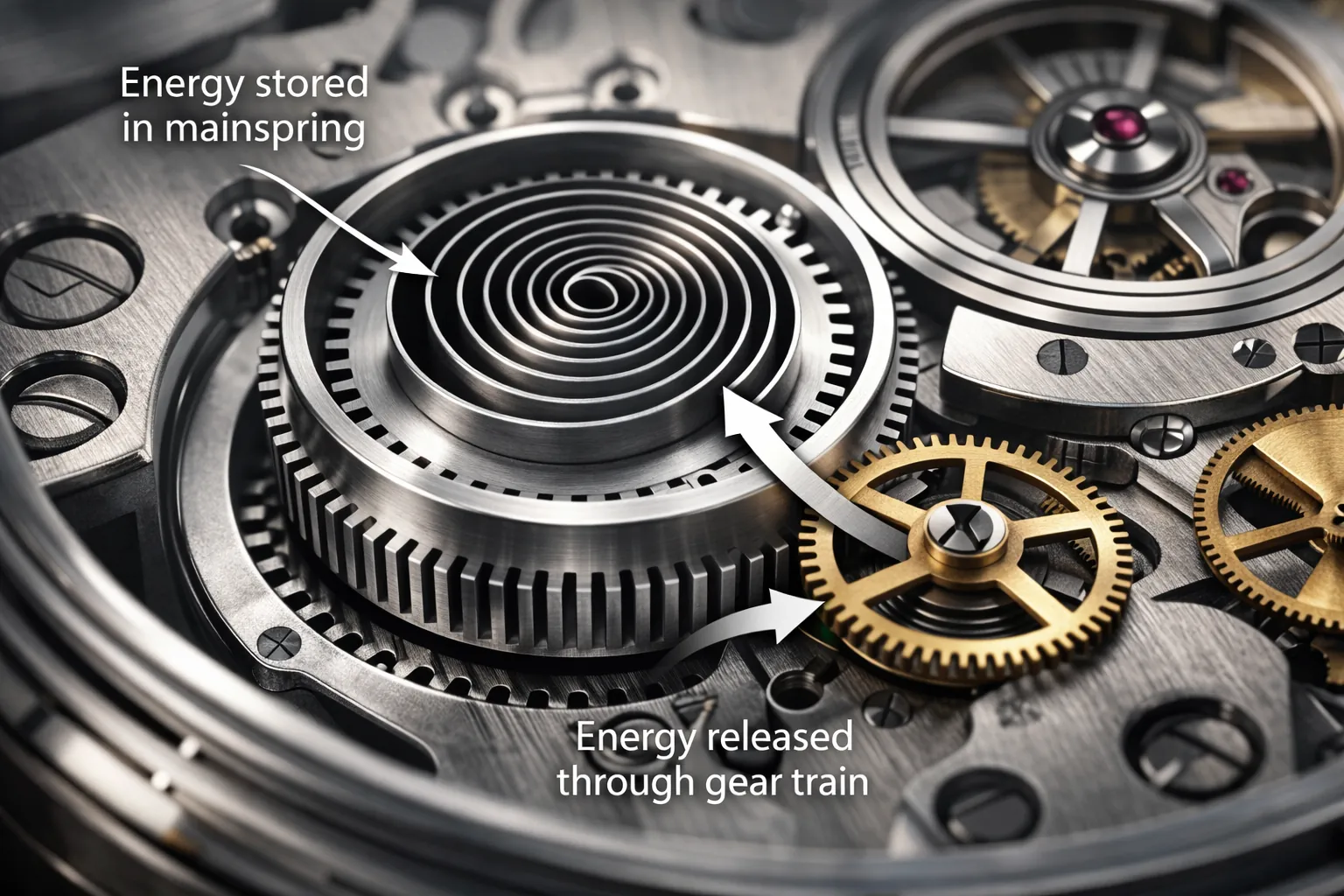
In a mechanical or automatic watch, energy is stored in the mainspring. As the spring slowly unwinds, it powers the movement. Power reserve is the amount of time the movement can keep operating once the watch is fully wound and left off the wrist.
If you’ve seen “42 hours”, “70 hours”, or “3 days” in specs, that’s the power reserve rating. It’s not a promise of accuracy— it’s a runtime estimate based on how the movement is designed and tested.
Where power reserve comes from (and what changes it)
Most watches store energy in a single mainspring barrel. Increasing power reserve usually means one (or a mix) of the following: a larger barrel, a longer/stronger mainspring, improved gear efficiency, or redesigned escapement/friction points. Some movements use multiple barrels in series to extend runtime smoothly.
Power reserve vs accuracy: related, but not the same
A common misunderstanding is that longer power reserve automatically means better timekeeping. In reality, accuracy depends on regulation, balance stability, lubrication condition, and how evenly torque is delivered. Many movements are designed to keep more stable amplitude through a useful part of the reserve.
The final hours of reserve can sometimes show slightly more variation (this depends heavily on movement design). For daily use, the bigger takeaway is: reserve helps convenience; accuracy is its own topic. If you want a deeper “daily performance” lens, see: mechanical watch performance explained (accuracy & durability).
What power reserve numbers mean in real routines
| Power reserve | Typical daily scenario | What you’ll notice |
|---|---|---|
| ~38–42 hours | Wear daily; occasional off-wrist overnight | Usually fine. If you skip a full day, you may need a quick wind + time reset. |
| ~50–55 hours | Workweek wear; light rotation with another watch | More forgiving. Less “dead watch” moments when rotating mid-week. |
| ~70–80+ hours | Weekend break; multi-watch rotation | Often still running Monday. Best for people who dislike frequent resets. |
Power reserve indicators: helpful tool or extra clutter?
Some dials include a power reserve indicator (a gauge that shows remaining energy). This can be especially useful if you: rotate watches, use manual-wind pieces, or want a quick visual “is it topped up?” check.
When an indicator is genuinely useful
If you put a watch down for a day or two, the indicator helps you avoid surprises—especially on manual-wind or low-activity days where automatic winding might not fully replenish the reserve.
When it’s mostly aesthetic
If you wear the same watch daily and your routine is consistent, the gauge often becomes “nice to have,” not essential.
How to make power reserve work for you (practical habits)
Daily-use checklist (no special tools required)
- Rotation planning: If you rotate watches, choose at least one with ~60h+ reserve to reduce frequent resets.
- Manual winding baseline: For a watch that’s stopped, a short manual wind before setting time can stabilize startup.
- Don’t “chase the last hour”: For best convenience, treat the final portion of reserve as buffer, not a goal.
- Mind your routine: Desk-heavy days may not wind an automatic as much as you expect (less arm movement).
Choosing the right power reserve without over-optimizing
It’s easy to turn specs into a competition. For most people, the right choice is simply the one that matches their wearing pattern: one-watch daily wear, occasional switching, or a full rotation.
If your priority is comfort and real-life durability—things that often matter more than a spec number—this daily-wear guide can help you frame decisions: daily wear watch considerations.

Quick summary: the simplest way to remember it
Power reserve is a convenience spec. It tells you how long the watch can run when you’re not wearing it. If you rotate watches or take breaks, longer reserve helps you avoid resets. If you wear one watch daily, standard reserve is usually enough. Use the number to match your routine—not to replace it.